Top 10 Types of Commercial Drip Irrigation Systems
Commercial drip irrigation is moving from a niche farm practice to a strategic water-management tool. FAO reports that agriculture accounts for about 70% of global freshwater withdrawals. That pressure makes precise irrigation increasingly important. It also makes poor design more expensive.
Market research reflects this shift. MarketsandMarkets estimates that the global drip irrigation market could grow from approximately USD 5.8 billion in 2023 to USD 10.6 billion by 2028. Estimates differ between reports, partly because manufacturers classify systems differently. Still, the direction is clear. Commercial operators are investing in emitters, filtration, fertigation, automation, and pressure control.
Daniel Hillel, an internationally recognized soil and water scientist, described drip irrigation as “the most efficient way to irrigate crops.” His statement remains useful, but efficiency is not automatic. A clogged filter, uneven pressure, or unsuitable emitter can waste water quietly. This guide examines the top 10 types of commercial drip irrigation systems, including surface drip, subsurface drip, inline emitters, online emitters, and integrated fertigation designs. Each type serves different crops, soil conditions, field sizes, and operating budgets. The right choice depends on evidence from the site, not marketing language. That sounds obvious. It is often ignored. Performance data, maintenance records, and local water quality should shape the final decision. The discussion also considers installation complexity, durability, labor demands, and measurable return on investment. No system is perfect. Even advanced commercial drip irrigation requires inspection, cleaning, and thoughtful redesign over time.
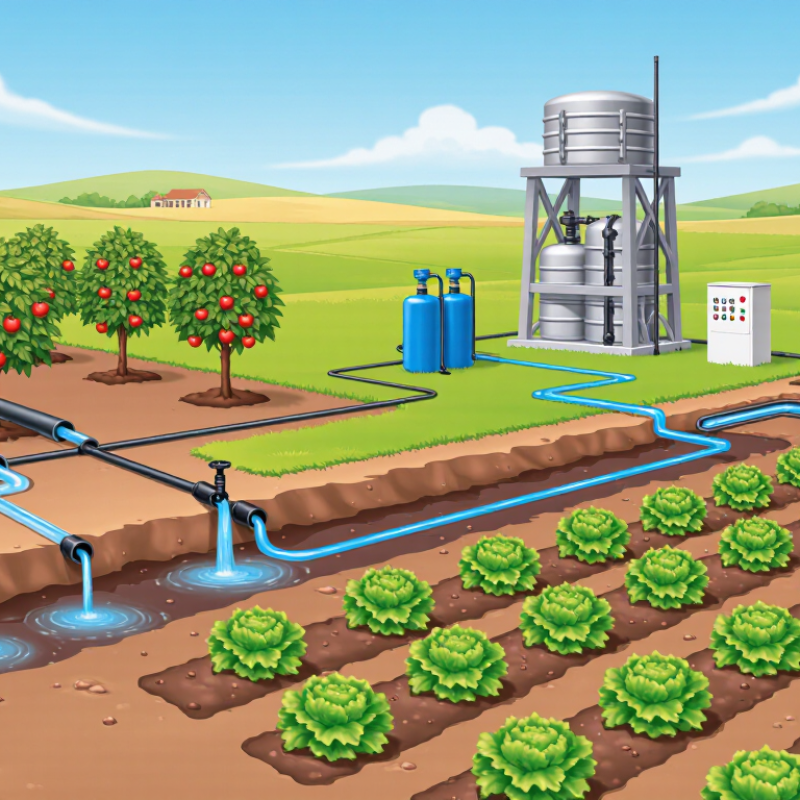
Basic Principles and Components of Commercial Drip Irrigation
Commercial drip irrigation applies water directly near plant roots, reducing evaporation and runoff. Each emitter releases a measured flow through small passages. A complete system usually includes a water source, pump, filter, pressure regulator, mainline, valves, laterals, and emitters. These components must work together.
Filtration is essential. Fine sand, algae, and organic particles can clog emitters within days. Pressure gauges help operators find weak zones or damaged lines. Common commercial types include surface drip, subsurface drip, drip tape, and point-source systems. Pressure-compensating emitters provide steadier flow across longer rows. Adjustable emitters suit containers and irregular plants. Subsurface lines save surface space, but leaks become harder to locate. The best design depends on soil texture, crop spacing, slope, water quality, and labor access. An experienced installer should test flow before covering lines. Our first layout once seemed efficient, yet uneven pressure left dry plants at the row ends. That mistake changed our maintenance checks.
Tips: Flush the system regularly. Check filters before peak irrigation periods. Place pressure gauges near the pump and farthest lateral. Inspect wet soil patterns, not only equipment. A dry patch may indicate clogging, root intrusion, or low pressure. Keep simple flow records after each repair. Small differences often reveal larger failures. Do not assume a new line is clean. Test it.
Top 10 Types of Commercial Drip Irrigation Systems - Basic Principles and Components of Commercial Drip Irrigation
| No. | System Type | Basic Principle | Core Components | Typical Commercial Uses | Main Advantages and Considerations |
|---|---|---|---|---|---|
| 1 | Surface Dripline System | Water is delivered through emitters installed in tubing placed on the soil surface. Each emitter releases a controlled, low-flow stream directly into the root zone. | Water source, pump, filtration unit, pressure regulator, mainline, submain, surface dripline, valves, connectors, end flush points, and optional fertigation injector. | Vegetable fields, orchards, vineyards, nurseries, greenhouses, and row crops where the tubing can be inspected or moved. | Easy to install, inspect, repair, and reposition. It can be exposed to sunlight, field traffic, wind, and animal damage, so anchoring and maintenance are important. |
| 2 | Subsurface Drip Irrigation (SDI) | Driplines are buried below the soil surface so water is released beneath the surface and moves laterally and upward through the soil by capillary forces and gravity. | Buried dripline, filtration and flushing equipment, pressure regulation, air/vacuum relief valves, distribution lines, control valves, and a system for locating or monitoring the laterals. | Field crops, permanent orchards, vineyards, turf, and other long-term plantings where consistent root-zone moisture is required. | Reduces surface evaporation and interference with cultivation. Installation, leak detection, root intrusion control, and flushing require careful design and management. |
| 3 | Inline Drip Emitter System | Emitters are factory-installed inside the dripline at a fixed spacing. Water passes through each internal flow path and exits at regular intervals along the lateral. | Inline emitter tubing, screen or disc filter, pressure regulator, mainline, submain, control valves, take-off fittings, and flush ends. | Uniformly spaced row crops, greenhouse beds, landscaped planting strips, and closely planted horticultural crops. | Provides consistent emitter spacing and fast installation. The selected spacing and flow rate must match soil type, crop spacing, slope, and required application depth. |
| 4 | Online or Punch-In Dripper System | Individual emitters are inserted into the wall of blank tubing or pipe at locations selected by the installer, allowing the outlet pattern to be customized. | Blank polyethylene tubing, online emitters, punch tool, pressure-compensating or non-pressure-compensating drippers, filter, regulator, valves, and end closures. | Orchards, container nurseries, landscape beds, irregular planting patterns, and crops with variable plant spacing. | Flexible spacing and easy replacement of individual emitters. Installation takes more labor, and poorly punched connections can create leaks or uneven distribution. |
| 5 | Pressure-Compensating Drip System | A pressure-compensating emitter uses an elastic diaphragm or similar mechanism to maintain a relatively stable discharge over a specified operating-pressure range. | Pressure-compensating emitters or dripline, properly sized filtration, pressure regulators, air-release valves, mainline, laterals, and flushing assemblies. | Sloping fields, long laterals, orchards, vineyards, greenhouses, and commercial landscapes where pressure variation may affect uniformity. | Improves flow uniformity across elevation changes and along longer runs. It generally costs more and still requires correct pressure control and filtration. |
| 6 | Non-Pressure-Compensating Drip System | Emitter discharge changes with the water pressure at the emitter. The system relies on careful hydraulic design to limit pressure differences throughout the block. | Non-pressure-compensating emitters or dripline, filter, pressure regulator, distribution pipe, valves, air-release devices, and flush points. | Short or level irrigation zones, small commercial plots, uniform beds, and applications with relatively stable inlet pressure. | Often economical and simple to operate. It requires shorter runs or carefully calculated pipe sizes where elevation and friction losses could reduce uniformity. |
| 7 | Drip Tape System | Thin-wall polyethylene tape contains regularly spaced emitters or molded flow paths that apply small amounts of water along annual or seasonal crop rows. | Drip tape, tape manifolds or headers, filtration, pressure regulation, valves, row connectors, end closures, and optional fertigation equipment. | Annual vegetables, strawberries, melons, cotton, field nurseries, and other high-value row crops. | Lightweight, efficient, and quick to deploy. It is more susceptible to punctures, crushing, clogging, and damage from excessive pressure than thicker-wall dripline. |
| 8 | Microtube Drip System | Small flexible tubes convey water from a distribution pipe to a plant or container. The outlet flow is controlled by the tube length, internal diameter, inlet device, or terminal emitter. | Microtubes, header or manifold, stakes, inlet restrictors or emitters, filter, pressure regulator, valves, and support fittings. | Container nurseries, greenhouse pots, hanging baskets, plant propagation, and small trees or shrubs with individually managed root zones. | Highly adaptable for individual containers and irregular layouts. Flow can vary when tubes are kinked, blocked, too long, or installed at inconsistent elevations. |
| 9 | Self-Flushing Drip System | The emitter or lateral design automatically releases a larger flushing flow when pressure changes or when the irrigation cycle begins, helping clear particles from the flow path. | Self-flushing emitters or laterals, filtration, pressure regulation, supply lines, control valves, air-release valves, and end-of-line flushing arrangements. | Commercial greenhouses, nurseries, orchards, and sites where frequent manual flushing is difficult or labor-intensive. | Can reduce routine flushing labor and help manage occasional particles. It does not replace proper filtration, water treatment, pressure control, or periodic system inspection. |
| 10 | Fertigation-Integrated Drip System | Soluble fertilizers or approved nutrients are injected into the pressurized irrigation water and distributed directly to the crop root zone through the drip network. | Dripline or emitters, filter, pressure regulator, injector or dosing pump, fertilizer tank, check valve or backflow protection, mixing equipment, valves, and flushing points. | Greenhouse crops, vegetables, fruit orchards, vineyards, nurseries, and other intensive commercial production systems. | Supports precise nutrient and water management while reducing broadcast application. Injection equipment must be calibrated, compatible with the water and fertilizer, and followed by adequate flushing. |
Related Posts
-
7 Tips for Choosing the Best Drip Irrigation System
-
2026 Top Commercial Drip Irrigation Manufacturers?
-
2026 Top Dig Drip Irrigation Types for Global Buyers
-
Who Are the Top Garden Drip Irrigation Suppliers in China?
-
What Are the 2026 Top Garden Drip Irrigation Systems?
-
What Is Drip Tube Irrigation and How Does It Work?